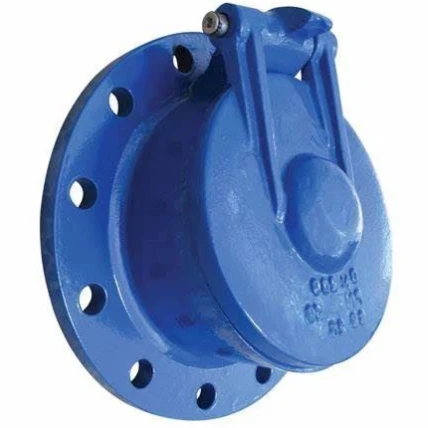
As a substitute for steel, ductile iron was developed in 1949. Cast steel contains less than 0.3% carbon, while cast iron and ductile iron contain at least 3% carbon. The low carbon content in cast steel is such that the carbon present as free graphite does not form structural flakes. The natural form of carbon in cast iron is in the form of free graphite flakes. In ductile iron, this graphite flakes are transformed into tiny spheres by a special treatment. This improved sphere makes ductile iron have more excellent physical properties than cast iron and steel. It is this spherical microstructure of carbon that makes ductile iron more ductile and impact resistant, while the flake form inside cast iron makes cast iron less ductile. Optimum ductility is obtained through a ferritic matrix, therefore all NIBCO Ductile Iron pressure loaded parts are treated with a ferritizing annealing cycle. The spherical structure inside the ductile iron can also eliminate the crack phenomenon that the flake graphite inside the cast iron is easy to produce. In micrographs of ductile iron, cracks can be seen traveling to graphite balls and terminating. Within the ductile iron industry, these graphite nodules are known as "crack stoppers" because of their ability to prevent fracture. Ductile iron is sometimes referred to as the "best of both worlds" metal, meaning that it has the strength of cast steel and the excellent corrosion resistance of cast iron.
Comparison of Ductile Iron and Cast Iron (Gray Iron) Compared with cast iron, ductile iron has an absolute advantage in terms of strength. The tensile strength of ductile iron is 60k, while that of cast iron is only 31k. The yield strength of ductile iron is 40k whereas cast iron does not show a yield strength and eventually breaks. The strength-to-cost ratio of ductile iron is far superior to that of cast iron. (see page 83 for a comprehensive comparison of mechanical properties). Ductile iron is the same as cast iron in terms of corrosion resistance.
Ductile Iron vs. Cast Steel The strength of ductile iron is comparable to that of cast steel. Ductile iron has a higher yield strength, with a minimum yield strength of 40k, while cast steel has a yield strength of only 36k. (see page 83 for a comprehensive comparison of mechanical properties). In most municipal applications, such as: water, salt water, steam, etc., the corrosion resistance and oxidation resistance of ductile iron exceed that of cast steel. Due to the spherical graphite microstructure of ductile iron, ductile iron is superior to cast steel in terms of vibration dampening ability, so it is more conducive to reducing stress. An important reason for choosing ductile iron is that ductile iron is cheaper than cast steel. The low cost of ductile iron makes this material more popular, casting more efficient, and less machining cost of ductile iron.