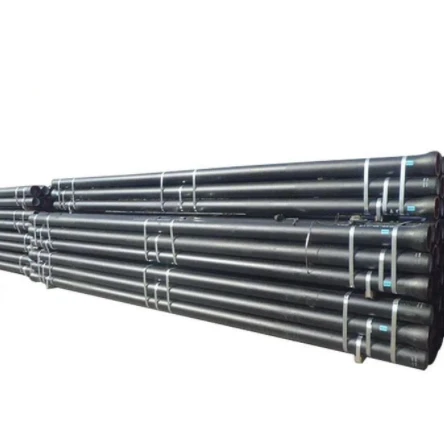
Ductile iron pipe is a type of cast iron, an alloy of iron, carbon and silicon. Graphite in ductile iron exists in spherical form, and the size of general graphite is 6-7 grades. In terms of quality, it is required that the spheroidization grade of the cast pipe should be controlled at 1-3 grades (spheroidization rate ≥ 80%), so the mechanical properties of the material itself The performance has been better improved, with the essence of iron and the performance of steel. The metallographic structure of the annealed ductile iron pipe is ferrite plus a small amount of pearlite, and its mechanical properties are good.
Ductile iron pipe is mainly called centrifugal ductile iron pipe. It has the essence of iron and the performance of steel, excellent anti-corrosion performance, good ductility, good sealing effect, easy installation, and is mainly used for water supply, gas transmission, and transportation in municipal and industrial and mining enterprises. oil etc. It is the first choice for water supply pipes with high cost performance. Compared with PE pipes, ductile ink tubes are simpler and quicker to install than PE pipes in terms of installation time, and the internal and external bearing pressure is better after installation; from the perspective of airtightness and corrosion resistance, ductile ink pipes are better airtight after installation, and also Various anti-corrosion methods can be used to improve the anti-corrosion performance; from the perspective of hydraulic performance, the specification of ductile ink tube generally refers to the inner diameter, and the specification of PE pipe generally refers to the outer diameter, because under the same specification conditions, the ductile ink tube can achieve greater runoff flow; from In terms of comprehensive installation and maintenance costs, the ductile ink tube has a more superior cost performance. The inner wall is sprayed with zinc, cement mortar anti-corrosion materials, etc.
Product Standards
GB/T 13295-2019 Ductile iron pipes, fittings and accessories for water and gas GB/T 17457 General Requirements for Cement Mortar Centrifugal Lining of Ductile Iron Pipes
GB/T 17458 Composition inspection of fresh mortar for cement mortar lining of ductile iron pipes by centrifugal method
GB/T 17459 Ductile Iron Pipe Bituminous Coating
GB/T 17456 Ductile iron pipe surface sprayed with zinc
GB/T 17219 Safety Evaluation Criteria for Drinking Water Transmission and Distribution Equipment and Protective Materials
Engineering standards
"Code for Construction Quality Acceptance of Building Water Supply, Drainage and Heating Engineering" GB50242-2002
Selection suggestions
1. The selection of ductile iron pipes should be based on the specific conditions of the laying site, and the interface form between straight pipes and fittings should be selected.
2. The rubber ring is usually made of NBR, SBR, EPDM and other materials.
3. Coating selection: choose a suitable coating according to the internal and external conditions during use. The existing inner coatings are new products of ductile iron pipes such as epoxy resin, polyurethane inner and outer coatings, and PE film coatings, and their properties should be understood in detail when selecting them.
In the medium and low pressure pipe network (generally used below 6MPa), the ductile iron pipe has the characteristics of safe and reliable operation, low damage rate, convenient and fast construction and maintenance, and excellent anti-corrosion performance. Generally not used in high-pressure pipe network (above 6MPa). Because the pipe body is relatively bulky, machinery must be used during installation. If there is water leakage after the pressure test, all the pipes must be dug out, the pipes must be hoisted to a height where they can be placed in the clamps, and the clamps should be installed to prevent water leakage.